Loose Ridge Caps
Caps that lift in wind leave a gap along the peak. Rain blows in and runs down the inside of the panels.

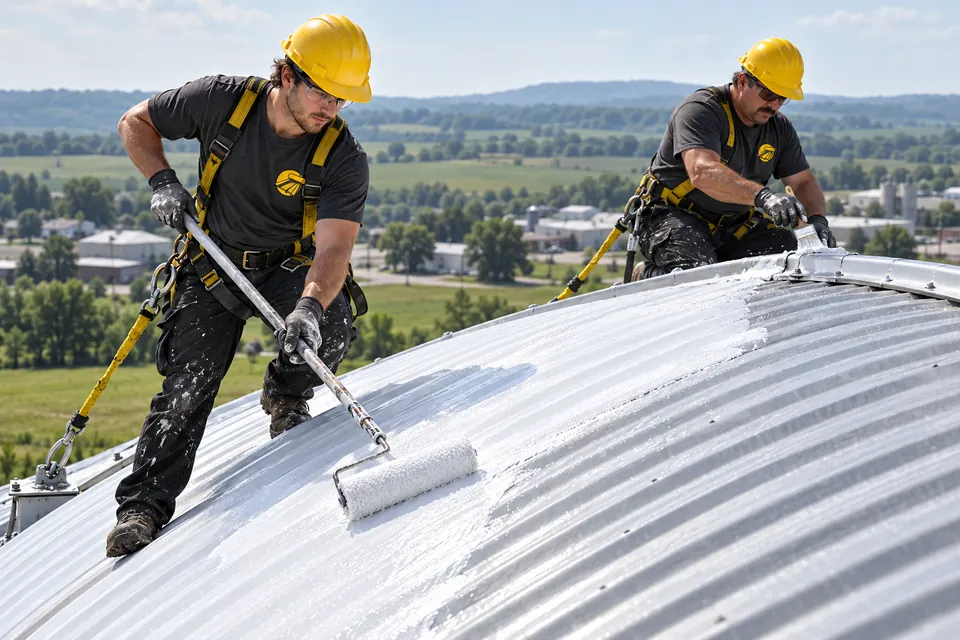
Bourbon County · Ridge Caps
We do metal roof coating in Millersburg for steel buildings, starting at the ridge, where loose caps and missing closures let wind-driven rain in.
The ridge takes the most wind on a steel roof, and that is where many leaks begin.
Ridge caps hold on with stitch screws and seal against the panels with foam closures. Over time the closures crumble, the screws back out, and wind-driven rain blows under the cap.
We check closures and stitch screws along the whole ridge line, refasten loose caps, and rebuild a cap line when it has failed. Then the ridge gets reinforced coating and the field follows.
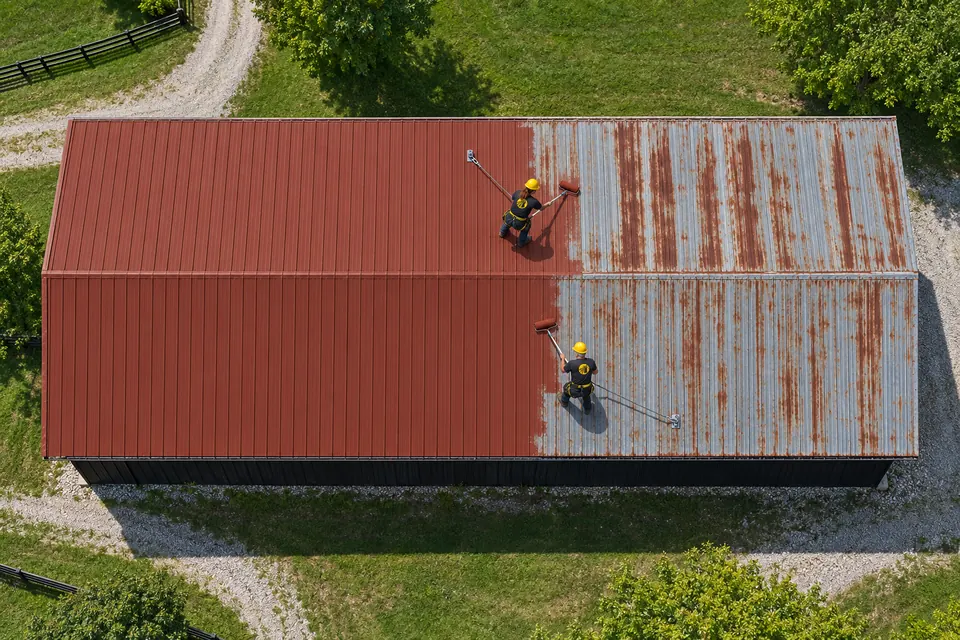
These six show up on many steel roofs around town.
Caps that lift in wind leave a gap along the peak. Rain blows in and runs down the inside of the panels.
Foam closures under the cap break down in sun and weather. Without them, wind pushes water straight past the ridge.
Stitch screws tie the cap to the panel ribs. When they back out or rust off, the cap starts to move.
Water trapped under a loose cap rusts the panel tops. Rusted sections get new panels before coating.
Grit washed down from the ridge fills the gutters and backs water under the trim. They get cleaned and sealed with the roof.
Laps just below the peak catch water blown past a loose cap. Rust starts there and spreads down the panel.
Rebuilding the ridge and coating the roof in Millersburg helps everyone tied to the building.
After the ridge is fixed, Millersburg roofs usually take one of these.
Caps, closures, and stitch screws get fixed, then screws, laps, and the field.
Steep, well-drained roofs take a light acrylic coat over the repaired ridge.
Buildings that need insulation can take foam with a topcoat over the whole roof.
Low lean-tos off a steep main roof often hold water at the eave and take silicone.
Water running down the inside walls after a windy rain? Call and tell us which side of the ridge.
Call UsRidge fixed and ready for a coat? Get a ballpark range in a few minutes.
Get A Free Ballpark EstimateThe ridge comes first because it takes the most wind.
We walk the ridge line and the field, then look inside for stains on walls and under the peak.
Closures get replaced, stitch screws added, and failed cap lines rebuilt.
Screws, laps, and rusted panel tops get fixed and primed.
The ridge gets reinforced coating, then the field is coated to thickness.
A last walk along the ridge checks every cap edge and stitch screw, and measures the coat on the roof field.
Besides Millersburg, we cover Winchester and the nine towns below. Somewhere else? Call us or send us a message.
7,558Residents · Montgomery County
County seat; roof units and vent boots first.
1,193Residents · Powell County
Powell County; storm checks on roof trim and ribs.
1,708Residents · Montgomery County
Pole barn roofs coated without new panels.
2,093Residents · Nicholas County
Nicholas County seat; roof scope kept to coating.
1,593Residents · Bath County
Bath County seat; storefront and steel roofs.
601Residents · Menifee County
Menifee County seat; skylight panels sorted first.
365Residents · Bath County
Bath County; purlins and holed panels fixed first.
610Residents · Bourbon County
Bourbon County; service masts at the roof edge.
1,020Residents · Montgomery County
Montgomery County; gutters and eave trim on shops.
Figures: 2020 U.S. Census counts for each city.
Millersburg sits in Bourbon County, where the state listing shows one local inspector covering Paris and the county, plus a state building inspector. Ask that office whether a Millersburg parcel falls under its coverage.
That matters most for new panels, a rebuilt ridge cap line, or raised curbs.
Foam closures under the cap break down, and stitch screws back out. Wind then pushes rain under the cap and down the inside of the panels.
New closures and tight stitch screws close that gap.
Yes, when the cap sits tight with new closures and screws. A cap bent out of shape or rusted through gets replaced first.
The coated cap gets reinforcement along both edges.
Mention any roof-mounted conduit or service mast that will be disturbed, because moving them brings electrical inspection into the job.
Keep the address and a short scope handy when you call the county office.
After any hard wind and once a year otherwise. Look for lifted cap edges and screws that stand proud of the cap.
Catching a loose cap early keeps a small refastening job from becoming a rusted peak.
In most cases. New closures, stitch screws, and refastened or replaced caps rebuild the line while the panels below stay.
Rusted panel tops near the peak get replaced only where needed.
Ridge vents get coated around, never over, so they keep breathing. Their flanges and fasteners get sealed with the rest of the ridge before the roof field is coated.
Start with a ballpark range, or call and tell us where the wind-driven leaks show up.
Or call (859) 204-8099
Leave a name and number and we will call you about the roof.
Rather talk now? Call (859) 204-8099