
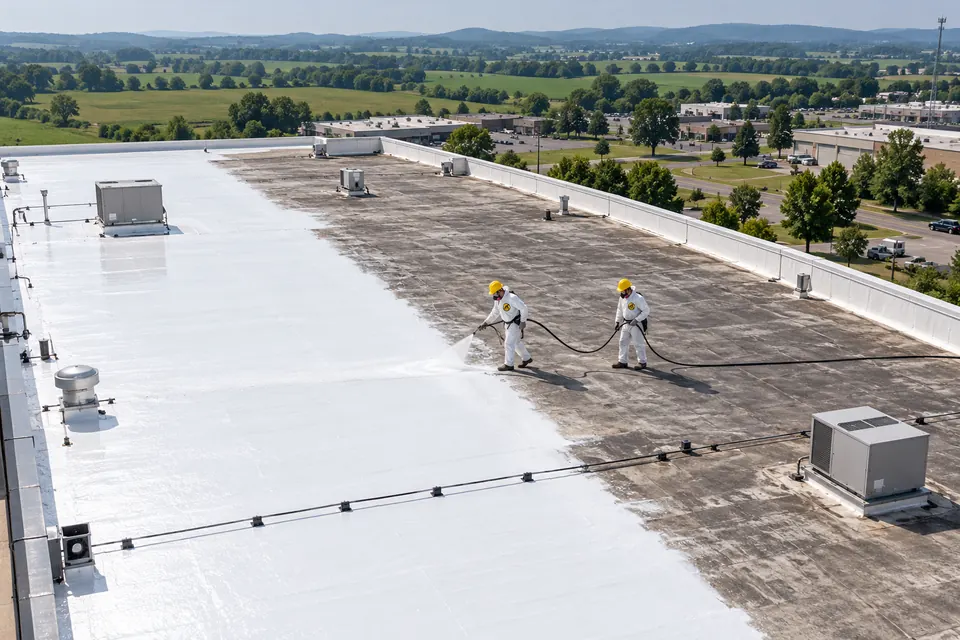
Aerial view of a coated commercial roof near Winchester, KY

Owner Questions, Answered Plainly

Winchester Metal Roof Coating Questions

Answers to the metal roof coating questions Winchester building owners ask most, from rust and screws to permits in each nearby county.

Topics
Rust, screws, laps, coatings
Permits
Every county we cover
Weather
Rain, freeze-thaw, storms
Cost
Drivers and Section 179

Metal Roof Coating Answers For Clark County

Metal roof coating is an elastomeric finish sprayed over steel panels, curing into a flexible skin over screws and laps. Winchester Metal Roof Coating coats commercial metal roof systems and handles silicone, acrylic, spray foam and shingle roof coating work in Winchester, Clark County, Kentucky, and Mount Sterling, Clay City, Jeffersonville, Carlisle, Owingsville, Frenchburg, Sharpsburg, Millersburg, North Middletown and Camargo.

Metal Roof Coating Basics

What goes into a metal roof coating, and why does it stop leaks?

Most metal roof coatings are elastomeric liquids, such as silicone or acrylic, that dry into a rubbery film thick enough to bridge small gaps at screws and laps. The film stretches as steel panels expand on hot afternoons and shrinks back overnight.

On an R-panel roof, crews treat the weak points first: every fastener head, each end lap, the ridge cap and the trim at the eaves. Those details get sealant or fabric-reinforced coating. The open field is then coated in one or more passes until it reaches the thickness the manufacturer calls for.

Which commercial metal buildings in the Winchester area can be coated?

Warehouses, machine shops, equipment buildings, churches, retail strips and agricultural steel buildings can all be coated when the panels are still structurally solid. The steel decides the answer, more than the type of building.

A good candidate has:

  • panels that feel firm when stepped on near the purlins;
  • rust limited to the surface, with no holes in the panel valleys;
  • enough slope to shed water instead of holding ponding near curbs.

Buildings with widespread rust-through, crushed ribs or shifted purlins need structural repair or new panels before coating is on the table.

What separates a roof coating from a full metal re-roof?

A coating renews the weatherproof surface of the panels already in place, while re-roofing removes them or covers them with new steel or a new membrane. Coating keeps the existing deck, trim and framing in service.

Because the panels stay, the building usually keeps operating during the work. Shelving and equipment inside stay put, and the roof gets fresh sealant at fasteners, laps and penetrations. Re-roofing makes more sense when panels are holed, purlins have moved or old patches cover so much of the roof that the steel underneath can no longer hold a screw.

Will a light-colored coating keep a steel shop cooler in summer?

White and light-colored coatings reflect more sunlight than bare galvanized or faded painted steel, so the roof surface runs cooler in summer and less heat passes through the panels into the work space underneath.

The U.S. Department of Energy's Guide to Cool Roofs measures roof coolness with solar reflectance and thermal emittance, and higher values on its 0-to-1 scale mean a cooler surface. Uninsulated shops and storage buildings notice the change most. Product-by-product ratings sit in the Cool Roof Rating Council's directory.

Rust, Fasteners and Seams

How much rust is too much to coat over?

Light surface rust is fine to coat after cleaning and priming, but steel with holes in it needs a patch plate or a new panel first. A coating covers metal; it will not rebuild metal that is gone.

Rust stageHow to spot itFix before coating
White rustPowdery white film on galvanized panelsWash, then a galvanized-rated primer
Surface red rustOrange bloom on firm steelWire brush and rust-inhibiting primer
Scaled red rustFlaking layers and pittingScrape to firm metal, prime, check thickness
Rust-throughPinholes or open holesPatch plate or panel replacement

Rust usually starts at the lower end laps and around fastener holes, where water sits longest.

Why do so many metal roof leaks start at screw heads?

Screw heads leak because the neoprene washer under each one hardens with age, splits and lets water track down the shank into the building. Daily panel movement also slowly backs screws out of the purlins.

During prep, crews check fasteners row by row:

  • Loose screws are snugged down or upsized.
  • Missing ones are replaced.
  • Stripped holes take an oversized fastener.
  • Each finished screw gets a cap of compatible sealant or reinforced coating.

A large R-panel roof can have hundreds of tired washers, which is why fastener work often takes longer than spraying the field.

What prep do side laps and end laps get?

Before any field coating, each side lap and end lap is scrubbed, dried and bridged with fabric-reinforced coating or a compatible seam tape. Those overlaps are where wind-driven rain and capillary action pull water uphill between panels.

End laps on long, low-slope runs need the most attention. The lower panel collects grit and moisture under the upper one, and rust often begins there. Crews look for open laps, missing stitch screws and old sealant that has pulled away, then build up each lap so the coating has a continuous base to bridge.

Do skylights, ridge caps and gutters get coated too?

Yes, and each of those parts gets its own repair step first, since skylights, caps and gutters flex and weather on a different schedule from the steel field. Leaving them out skips the most common leak points.

  • Skylight panels: clouded or cracked fiberglass gets replaced or covered, and intact panels get sealed laps.
  • Ridge caps: closures and stitch screws are checked, and loose caps are refastened before coating.
  • Gutters: built-in and hung gutters are cleaned, rust-treated and coated where the system allows.

Curbs around rooftop units and pipe flashings follow the same pattern, with reinforced coating worked into every seam.

Should a standing seam roof be treated differently than R-panel?

Prep differs, because a standing seam roof hides its fasteners in clips under the seams, while an R-panel roof puts screws through the face of every sheet. The coating steps match, but the leak points differ.

DetailStanding seamExposed-fastener R-panel
FastenersConcealed clips under the seamsExposed screws in every panel
Main leak pointsSeam terminations, pipe boots, trimWashers and laps
Prep focusSeam and end-dam sealingFastener tightening and sealing
Panel movementSlides on clipsStrains each screw hole

Before coating standing seam, crews check that the coating will leave the seams free to move as the panel maker intends.

Choosing a Coating

Should a metal roof get silicone or acrylic?

Silicone tolerates standing water better, while acrylic suits steeper, well-drained metal roofs in full sun. Many metal buildings with good slope can use either, so drainage, recoat plans and budget decide it.

FactorSiliconeAcrylic
Standing waterHandles it wellBreaks down if water sits
Future recoatOnly silicone bonds well to itAcrylic recoats bond readily
Dirt pickupTends to hold dustStays cleaner on slopes
Application weatherHandles cooler, damper daysNeeds dry days well above freezing
Primer on metalOften requiredOften required

Compare data sheets side by side, and check each product's listing with the Cool Roof Rating Council.

Silicone roof coating · Acrylic roof coating

Is spray foam over metal panels worth it?

Spray polyurethane foam makes sense when a metal building needs added insulation, drips condensation from the panels or has rib profiles that trap water and debris. The foam fills the ribs and creates a new, continuous surface that is then coated.

QuestionCoat the panelsFoam, then coat
Adds insulationVery littleYes, closed-cell foam
Fills panel ribsNoYes
Added weightVery lightMore, still modest
Best fitFirm panels, insulation in good shapeCondensation, heat loss, worn surface

A DOE Building America guide puts aged closed-cell foam near R-6 for each inch of thickness.

Spray foam over metal panels

Do shingle roof coatings work on commercial shingle roofs?

A coating can extend a commercial asphalt shingle roof whose shingles are flat, well adhered and mostly intact, such as on a strip center, office or church. Curled, brittle or bald shingles are past the point where a coating helps.

Two checks come first:

  1. Manufacturer terms. Certain shingle brands limit what can go over their product, so read the existing coverage terms.
  2. Shingle condition. Granule loss, cupping and soft decking show up on a close walk.

Where a building pairs a shingled front with a metal or low-slope rear section, each area gets matched to its own system.

Coatings for commercial shingle roofs

Do galvanized or painted metal roofs need a primer?

Primer is the step that lets coating grab steel that is chalky, galvanized or rusted, and most metal coating systems call for one in at least some areas. Chalky factory paint gets a wash and, on some roofs, a bonding primer.

Crews often run an adhesion test. A small patch of the chosen coating is applied, left to cure and then pulled to see how well it bonds. That test shows which primer, if any, each roof area needs. Rusted fastener lines, ridge caps and end laps tend to get a rust-inhibiting primer even when the open field passes without one.

Is there a coating option for metal roof areas that hold water?

Silicone is the usual choice for metal roof areas that hold water, such as low spots near gutters, behind curbs or along a valley. Ponding on metal usually points to a sagging purlin, a crushed rib or packed debris, so the cause gets found before coating.

On low-slope metal, crickets behind rooftop units can steer water toward the eaves. Spray foam can also be shaped to add slope in small areas. Where a whole bay sags between frames, the framing needs repair first, since coating over a structural dip leaves the water where it was.

Weather Around Winchester

Why does heavy rainfall matter for coated metal roof details?

Heavy rain finds the details of a coated metal roof first, since water concentrates at end laps, gutters and valleys. The NWS Louisville 2024 annual climate summary shows nearby Lexington receiving about 50 inches of precipitation that year.

With that much rain:

  • gutters and downspouts need room to carry water clear of the walls;
  • end laps on low-slope runs should be built up and sealed;
  • coating days get scheduled around dry stretches so each coat cures before the next shower.

Clogged gutters on a metal building back water under the eave trim, so clean them before and after coating.

Do freeze-thaw swings hurt metal roof coatings?

Sharp temperature swings make steel panels grow and shrink, and that movement works at fasteners, laps and old sealant. An elastomeric coating is made to stretch with the steel instead of cracking like aged caulk.

Winters near Winchester swing hard. In January 2024, the Lexington station went from 7 degrees under zero to the mid-60s within a few days, per the same NWS Louisville summary.

After a cold season, walk the roof and look for split sealant at ridge caps, gaps opening at end laps and screws that have backed out. Catching those early keeps a small lap repair from turning into a stained ceiling tile.

What should owners check after a severe storm?

After hail or high wind, walk the building perimeter first and look for lifted trim, bent gutters and loose ridge caps before anyone climbs. Wind tends to get under eave trim and rake edges before it disturbs the field.

On the roof, look for:

  • hail dents along the ribs and split coating over them;
  • punctures or cracks in skylight panels;
  • fasteners pulled loose near the eaves;
  • limbs and leaves jammed in gutters and valleys.

Photograph damage with the date before cleanup. Look up your county's forecast office at weather.gov, since NWS Louisville and NWS Jackson split central and eastern Kentucky between them.

Prep, Application and Downtime

In what order does a metal roof coating crew work?

A coating crew works in a set sequence, from the first inspection to a closing walk-through on the finished surface.

  1. Inspect your roof one panel at a time and check the deck from inside.
  2. Wash off dirt, chalk and loose rust.
  3. Repair fasteners, holed panels, skylights and trim.
  4. Prime rusted or chalky areas.
  5. Seal laps, seams, curbs and flashings with reinforced coating.
  6. Coat the field to the specified thickness.
  7. Walk the roof and check film thickness.

No stage starts until the one before it has cured, so weather sets the calendar.

Inspect your roof: request an estimate

Will the building have to close during coating?

Shops, warehouses and offices keep running through most metal roof coatings, since crews stay on the roof surface and nothing gets torn off. The loudest days are the pressure washing and screw replacement days.

Plan for:

  • staging space near the building for equipment and a lift;
  • shielding rooftop air intakes during spraying so odor stays out;
  • covering vehicles and inventory near the walls if overspray is a risk;
  • short pauses at doorways while crews work overhead.

Spray foam brings more setup, including masking and wind limits, than a rolled acrylic job.

How much cure time does each coat need?

Cure time depends on coating type, film thickness, temperature and humidity, and each product data sheet sets its own windows.

Acrylics dry by losing water, so they need warm, dry air and no rain until they skin over. Silicones cure with moisture from the air and handle damper days better. Spray foam has to be top-coated within the window its maker sets, because sunlight breaks down an exposed foam surface.

Cool mornings matter too. Dew on the panels at dawn can hold off the first coat until the steel dries.

Which months work best for coating metal roofs in Clark County?

Around Winchester, the steadiest coating weather runs from mid-spring into early fall, when nights stay above the minimums on most data sheets and panels dry early. Fall work has to wrap up before frost lingers on the steel into midmorning.

Silicone stretches the season somewhat because it cures with humidity. Acrylic wants several dry, warm days in a row. In practice, scheduling follows a run of forecasts rather than a calendar date, and prep work like fastener replacement and lap sealing can start before coating weather settles in.

Got A Question About Your Own Roof?

Leaking Now?

Answers here cover most roofs. For a leak on yours, call and tell us where the water shows up inside.

Call Us

Planning A Coating?

Turn these answers into a number: seven questions give a ballpark range for coating your roof.

Get A Free Ballpark Estimate

Cost, Value and Taxes

Which roof conditions push coating costs up or down?

Roof size, repair volume and the chosen coating system set most of the price of a metal roof coating. Two roofs of equal size can differ widely if one needs hundreds of fasteners and new skylight panels.

Main cost drivers:

  • Square footage and eave height, which set lift and access needs.
  • Fastener count and how many need replacing.
  • Rust repair, including patch plates or new panels.
  • Coating type and total film thickness.
  • Detail work at curbs, gutters, skylights and ridge caps.
  • Spray foam thickness when insulation is added.

How do you decide between coating, restoration, new panels and a new roof?

Steel condition decides the path, with coating for worn but firm panels and replacement for failed structure.

OptionRoof conditionWork involved
CoatFirm panels, light chalking, few leaksClean, prime, coat
RestoreLeaks at fasteners and laps, surface rustFastener work, lap sealing, rust treatment, coating
Re-panelHoled or crushed panels in some areasNew panels where needed, then coat
ReplaceFailed purlins, widespread rust-throughNew roof system

One building can land in two rows, such as a coated main roof with new panels over a rusted lean-to on the back wall.

Does Section 179 cover coating a commercial metal roof?

IRS Publication 946 counts roofs among qualified real property improvements, so roof work on an existing nonresidential building can be expensed under Section 179.

For 2026 the cap is $2,560,000, shrinking dollar for dollar once a year's qualifying purchases pass $4,090,000, per the same publication. Residential rental property is excluded.

The tax treatment of each line item, from coating to new screws and panels, on a particular warehouse or shop is a question for a CPA. Bring an itemized invoice that separates repair work, such as patch plates and skylight panels, from the coating itself.

Permits, Codes and Utilities

Who issues commercial roof permits around Winchester?

Commercial roof permits around Winchester come from the local Winchester and Clark County office or the Kentucky Department of Housing, Buildings and Construction (HBC), depending on the county.

State listings show no local inspector for Montgomery, Powell, Nicholas or Menifee, a city-only one in Bath and a Paris-and-county one in Bourbon.

TownCountyBuilding permits
WinchesterClarkWinchester Building Inspections
Mount SterlingMontgomeryKentucky HBC (county listing)
JeffersonvilleMontgomeryKentucky HBC
Clay CityPowellKentucky HBC (county listing)
CarlisleNicholasKentucky HBC (county listing)
OwingsvilleBathLocal inspector, City of Owingsville only (county listing)
SharpsburgBathConfirm with Kentucky HBC
FrenchburgMenifeeKentucky HBC (county listing)
MillersburgBourbonBourbon County inspector (county listing); confirm city coverage
North MiddletownBourbonBourbon County inspector; confirm city coverage
CamargoMontgomeryKentucky HBC

Coating-only work still deserves a call to the right office.

Service areas around Winchester

Do zoning or floodplain rules apply to metal roof work?

Zoning and floodplain offices usually get involved only when roof work changes the building, such as raising a roof line, adding curbs or moving equipment. A recoat over existing panels rarely touches zoning.

Some cities keep a planning and zoning office separate from building permits, so a project that adds rooftop units or changes how water leaves the roof can need both.

Ask about floodplain status for buildings near creeks and rivers, since substantial improvements on floodplain parcels can trigger extra review. Have the property address and a short description of the work ready when calling.

Which electric utilities serve the Winchester area?

Electric service around Winchester comes from an investor-owned utility or a rural cooperative, and the name on the bill settles which one. Clark Energy is among the owner-member cooperatives listed by East Kentucky Power Cooperative, and that list shows Clark Energy and Jackson Energy serving Powell County.

Knowing the provider matters on a metal roof job for two reasons:

  • service masts and meter feeds that pass through or along the roof edge need coordination before panels are worked;
  • efficiency programs, where offered, run through that provider.

Can a roof coating earn a utility rebate?

Utility programs change often, so ask your electric provider about current business programs before counting on any rebate for a coating or added insulation. Each utility sets its own rules.

Kentucky Utilities customers can review LG&E and KU's business programs, which include a custom path where insulation appears among eligible measures, subject to program rules.

Cooperative members should ask their own co-op. Planning foam over the panels? Bring up the added insulation and ask about pre-approval before the first roof section is sprayed.

Questions by Town

Where do Winchester businesses apply for a roof permit?

Winchester businesses apply through the city's Building Inspections department, which issues permits for structures of 200 square feet or larger inside Winchester and across all of Clark County. The state's Clark County listing shows one local building inspector serving both the city and the county.

That shared office means a warehouse in town and a metal equipment building on a county road follow the same permit path. The department also handles plan review, so larger changes such as new panels, added rooftop units or structural repairs can be reviewed locally. For coating-only work, call ahead to confirm whether a permit applies.

Does roof work in Winchester ever need an electrical or demolition permit?

Winchester's Building Inspections department issues electrical and demolition permits alongside building permits, so roof work that touches wiring or removes a structure can need one. A straight recoat involves neither.

Jobs that bring in the electrical side:

  • relocating a rooftop conduit run or junction box to reach rusted panels;
  • moving or replacing light fixtures mounted on eave trim;
  • disconnecting a rooftop unit so its curb can be raised.

Tearing down a rusted lean-to before coating the main roof falls on the demolition side. That office also requires permits for new or changed parking lots, which matters if a project adds a paved staging area.

Which office permits commercial roof work in Mount Sterling?

Commercial construction permits for Mount Sterling buildings go through the Kentucky HBC, because the state's Montgomery County listing leaves the local building inspector line blank and refers commercial work to the department.

For a metal roof, the state path matters most when the job grows past coating. New panels over a rusted section, added skylight framing or a raised curb for new rooftop equipment can trigger plan review.

Before work starts, write the scope down in plain terms, such as panel count, fastener replacement and any structural repair, so the state office can say what applies.

Metal roof coating in Mount Sterling

Who inspects rooftop HVAC and plumbing vent changes in Mount Sterling?

Montgomery County's state listing names an HVAC inspector, plus a plumbing inspector based at the Montgomery County Health Department, so changes to rooftop units or vent stacks on a Mount Sterling building involve those trades as well as the roof crew.

Coating projects touch these items more often than owners expect:

  • curbs under rooftop units get raised or rebuilt when they sit too low for proper flashing;
  • vent stacks get new boots where the old rubber has split;
  • gas lines running across the panels get lifted onto supports.

Line up the HVAC and plumbing contractors before coating starts, so the roof is sealed once, after their work.

Metal roof coating in Mount Sterling

Is Jeffersonville handled by the same offices as Mount Sterling?

Jeffersonville sits in Montgomery County alongside Mount Sterling, so commercial building permits for both go through the Kentucky HBC. Local electrical work splits differently, because the listing hands it to either the city where the building sits or the County Judge Executive.

For a Jeffersonville metal building, that means:

  • inside Jeffersonville city limits, ask the city office about electrical work;
  • outside city limits, the county handles it;
  • building permits stay with the state either way.

Check the parcel's location before moving roof-mounted conduit, lighting or a service mast, so the right office signs off.

Metal roof coating in Mount Sterling · Metal roof coating in Jeffersonville

Can a Jeffersonville pole barn or equipment shed be coated without new panels?

A pole barn or equipment shed near Jeffersonville can be coated without new panels when the steel is firm, the purlins are straight and rust has not eaten through the valleys. Holed sheets get replaced first, then the whole roof is coated.

Older shed roofs show their own wear:

  • open eaves where birds nest and wind lifts trim;
  • end laps loosened by years of equipment vibration;
  • skylight strips yellowed to the point of cracking.

Because Montgomery County has no local building inspector, ask the Kentucky HBC whether the building's use calls for a permit before panel replacement or structural repair begins.

Metal roof coating in Jeffersonville

Where do Clay City owners get a permit for metal roof work?

Clay City permits for commercial building work come from the Kentucky HBC, since Powell County relies on the state office. Its Powell County listing points commercial projects there.

That state path covers a downtown storefront and a metal shop on a county road alike. Coating alone often stays outside permit review, but panel replacement, new skylight framing, raised curbs or repairs to rusted purlins move a project into the state's hands.

Describe the work by roof area and repair type when contacting the office, and keep the response with the building's records.

Metal roof coating in Clay City

Which utilities and weather office cover Clay City buildings?

Clark Energy and Jackson Energy both serve Powell County, per East Kentucky Power Cooperative's member list, and NWS Jackson issues the county's weather warnings.

Those two facts shape roof planning in Clay City:

  • call whichever cooperative appears on the bill when a service mast passes through the roof or a meter base sits on the eave wall;
  • Jackson office warnings for hail and high wind are the cue for a post-storm roof walk.

After a Jackson warning, check ridge caps, eave trim and skylight panels first, then look for hail dents along panel ribs.

Metal roof coating in Clay City

Where do Carlisle businesses get a commercial roof permit?

Carlisle businesses get commercial building permits from the Kentucky HBC, because the state's Nicholas County listing names no local inspector and directs commercial construction to the state.

A Carlisle project that stays within coating, fastener replacement and lap sealing tends to be the simplest case. Once a scope adds new panels, cuts in new rooftop penetrations or rebuilds a section of framing, ask the state office what review applies.

Keep a short written scope and a few roof photos handy for that conversation, since they answer most first questions.

Metal roof coating in Carlisle

What electrical and trade inspections apply to Carlisle metal buildings?

Electrical inspection for a Carlisle job goes to the city or to the Nicholas County Judge Executive, based on where the building stands, and the same state listing names HVAC, plumbing and state electrical inspectors for the county.

Roof work on a Carlisle metal building brings those trades in when:

  • conduit strapped to the panels has to be lifted for fastener work;
  • a rooftop unit gets disconnected so its curb can be reflashed;
  • vent stacks need new boots before the coating goes on.

Schedule those trades ahead of coating so their penetrations are sealed in the same pass as the rest of the roof.

Metal roof coating in Carlisle

Is there a local building inspector in Owingsville?

Owingsville has a local building inspector, and the state's Bath County listing limits that inspector to the City of Owingsville only. A commercial metal building inside city limits starts there for building permits.

That city-only coverage makes the parcel line important, since a storefront in town and an equipment building out in the county can follow different permit paths. Confirm city limits before ordering new panels or raising curbs.

Bath County's listing sends local electrical questions to the County Judge Executive or to the city where the job sits.

Metal roof coating in Owingsville

Where does a Sharpsburg business check permits for metal roof work?

A Sharpsburg business should start with the Kentucky HBC, since Bath County's only listed local building inspector covers the City of Owingsville alone. The state's Bath County listing also names state building, electrical, HVAC and plumbing inspectors for the county.

Before panel replacement or purlin repair on a Sharpsburg shop or storefront, call the state office with the address and a short scope. When coating work means lifting conduit or reflashing a service mast, ask the Sharpsburg city office or the County Judge Executive's office about electrical inspection, based on where the building sits.

Metal roof coating in Sharpsburg

Who handles commercial roof permits in Frenchburg?

Commercial roof permits in Frenchburg go through the Kentucky HBC, since the state's Menifee County listing has no local building official and tells commercial builders to contact the department.

For a Frenchburg metal building, split the scope into coating work and structural work when calling. Rusted purlins, new skylight framing and rebuilt curbs are the items most likely to need review.

Menifee's listing leaves local electrical questions with the County Judge Executive or the city hosting the work, which comes up when eave lighting or roof-mounted conduit has to move before coating.

Metal roof coating in Frenchburg

Which inspector covers roof work in Millersburg?

Millersburg sits in Bourbon County, where the state listing shows one local inspector covering Paris and the county, plus a state building inspector assigned there. Ask that office whether a Millersburg parcel falls under its coverage before panel or framing work starts.

The answer matters most when a scope goes past coating:

  • new panels over a rusted section;
  • a rebuilt ridge cap line;
  • raised curbs under rooftop units.

Keep the address and scope handy, and mention any roof-mounted conduit or service mast that will be disturbed, since that brings electrical inspection into the job.

Metal roof coating in Millersburg

Which electric provider should a North Middletown owner contact before roof work?

North Middletown owners should contact the provider printed on their electric bill, because the Bourbon County area has more than one. The City of Paris new resident packet lists Kentucky Utilities, Blue Grass Energy and Clark Energy alongside the city's own electric department.

On a metal building, that call comes before work near a service mast, a meter base on the eave wall or a weatherhead poking through the panels. Coating around those items needs a clean flashing boot and safe clearance. For permits, the Bourbon County listing names the county's local inspector, so confirm North Middletown coverage there first.

Metal roof coating in North Middletown

How do permits work for a Camargo property in Montgomery County?

Camargo properties in Montgomery County get commercial building permits through the Kentucky HBC, because Montgomery County has no local building inspector on its state listing.

Electrical inspection follows a split. The listing points it to the County Judge Executive's office or to the city office where work takes place, so a Camargo address outside any city's limits falls to the county side.

That route applies when roof work lifts conduit, swaps eave lighting or reflashes a service mast on a metal shop or warehouse. Check the tax bill to confirm whether the parcel lies inside a city before calling.

Metal roof coating in Camargo

Getting Started

What information speeds up the first roof walk?

A few facts about the roof's past and some photos of ceiling stains save time on the first walk. Gather what is easy to find; gaps are fine.

Helpful items:

  • Approximate roof age, panel profile and past coatings or patches.
  • Leak spots marked on a rough floor plan.
  • Photos of stains, drips or rust spots on the underside.
  • Gate codes, lift space and the hours crews can work.
  • The electric provider's name, if work near a service mast is likely.

Note any skylight panels that have already been patched, since those often hide older leaks.

What happens during the first roof inspection?

The first inspection is a full walk of the roof to check every fastener line, lap, seam, skylight panel, gutter and curb, and a pass underneath through the building's interior.

Crews note:

  • rust type and spread, from white rust to rust-through;
  • loose, missing or stripped fasteners;
  • open end laps and failing sealant;
  • ponding, crushed ribs and sagging purlins;
  • condensation stains that point toward spray foam.

From those notes, each roof area gets sorted into one of four paths (coating, restoration, new panels or a new roof), and the owner gets a plain explanation of what the roof needs first.

Still Have A Roof Question?

Call and ask about your building, or start with a ballpark range for coating it.

Or call (859) 204-8099

Call Us (859) 204-8099